
Tatiana Trouvé’s first solo exhibition at Xavier Hufkens gallery in Brussels, “The Auxiliaries,” officially opened on September 10. The French-Italian artist transforms the gallery’s three floors into an open ecosystem of memory, journey, and invisible labour, weaving together sculpture, drawing, and installation into an ever-expanding web of meaning.

Trouvé’s work has always inhabited the coexistence of multiple realities. She has said: “All the elements that make up worlds [are] connected to each other through affinities, echoes, reminiscences, and how these liaisons map out a shared wandering, without origin or end, in a completely open ecosystem.”
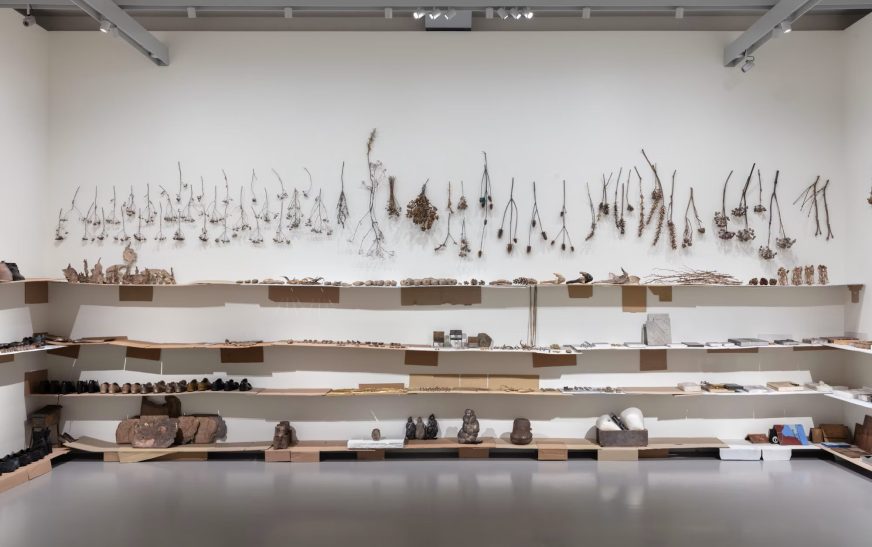
The exhibition opens with a new 2026 work, L’Inventario (The Inventory). This seemingly temporary shelving structure, cast in aluminium to resemble cardboard, juxtaposes still-life compositions with empty shelves. The studio is concretised as a place of transformation—where objects and their relationships exist in a perpetual state of “becoming.” As Trouvé puts it: “The idea is to get into a space where a few elements still survive, but where the essentials are already gone.”
Traces of journey and time run throughout. Les Colliers des villes (City Necklaces) are composed of objects collected by the artist during her travels, cast in bronze, brass, steel, or aluminium, and then hand-painted. These fragments become condensed itineraries, carrying traces of encounters and lived experience, echoing the interwoven paths of Italo Calvino’s Invisible Cities.
On the Eve of Never Leaving (2026) adds another dimension—a work based on sound pollution measurements taken around the Boulevard Périphérique that encircles Paris. Here, sounds become lines, movements become structures, and an invisible phenomenon acquires material presence. An adjoining plaster panel, a fragment of Trouvé’s studio wall, recalls the acoustic barriers lining the motorway—connecting the artist’s studio life to the murmuring of the world.
In the basement, the 2026 work Sitting Sculptures, from the series Les Ouvrières invisibles (The Invisible Workers), foregrounds the “auxiliary materials” that enable sculptures to exist: mattresses, blankets, pillows, transport pallets, lifting straps, silicone fragments… These materials, once used to drag heavy objects around the studio, reappear in new forms. They retain traces of their histories even as they assume new identities—revealing the hidden movements and labour embedded within sculptural practice.
Upstairs, the porous relationship between drawing and sculpture comes to the fore: the Les Dessouvenus (The Unremembered) series, begun in 2013, is shown alongside a new series of drawings, Les Auxiliaires (The Auxiliaries). Here, worlds emerge from chemically altered surfaces, while drawings originate in the chance event of a hair falling across a canvas.
As the boundaries between studio and exhibition, drawing and sculpture, process and finished work gradually dissolve, Tatiana Trouvé’s works emerge not as fixed entities, but as temporary constellations within an open network of transformations. The shifting relations between objects, materials, gestures, and places continuously generate new meaning—precisely as the exhibition itself reveals.
The exhibition runs from September 10 to October 31, 2026, at Xavier Hufkens gallery in Brussels.
FAQ
Q: When and where is Tatiana Trouvé’s exhibition “The Auxiliaries” taking place?
A: The exhibition runs from September 10 to October 31, 2026, at Xavier Hufkens gallery in Brussels.
Q: What series of works are included in the exhibition?
A: The exhibition presents new works including L’Inventario (2026), Les Colliers des villes, On the Eve of Never Leaving, Sitting Sculptures (2026), as well as works from the Les Dessouvenus and Les Auxiliaires drawing series.
Source: Xavier Hufkens